Regional Tariff Response Initiative (RTRI): Eligibility, Funding & Application Guide Home Tariffs and unpredictable trade agreements can impose financial strain...
Tariffs and unpredictable trade agreements can impose financial strain on Canadian businesses. Higher input costs, disrupted supply chains, reduced revenue, changing customer demand and challenges in accessing markets can affect both day-to-day operations and longer-term business plans.
For businesses facing these pressures, the Regional Tariff Response Initiative (RTRI) provides government funding designed to help eligible businesses maintain operations, address liquidity pressures,improve productivity, diversify into new markets, and strengthen resilience. The initiative is delivered through Canada’s Regional Development Agencies (RDAs), so eligibility and application requirements can vary by region.
For eligible businesses, the current RTRI structure can provide up to $3 million in combined non-repayable funding, consisting of up to $2 million in liquidity assistance and up to $1 million for a non-repayable pivot project. When repayable support is included, eligible businesses may receive up to $20 million in total RTRI funding, subject to program and regional requirements.
The Regional Tariff Response Initiative (RTRI) is a Government of Canada funding program designed to help eligible businesses affected by tariffs and trade disruptions. The initiative provides financial support to businesses facing tariff-related challenges, including cash-flow pressures, increased operating costs, supply-chain disruptions, and changing market conditions.
Canada’s Regional Development Agencies RDAs are providing $3.45 billion in support through tariff-response measures. to support affected businesses.
RTRI support is available through two key areas: liquidity assistance and pivot projects.
Liquidity assistance can help eligible businesses address immediate financial pressures and maintain essential operations.
Pivot projects support investments that can help businesses adapt to changing trade conditions, improve productivity, diversify markets, and strengthen their long-term resilience.
The initiative is delivered through Canada’s regional development agencies, so eligibility, eligible costs, and application requirements may vary by region. Businesses considering RTRI should review the requirements of the relevant regional agency before applying.
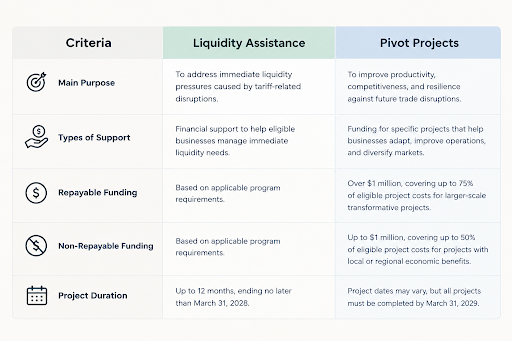
The current RTRI structure provides two main types of support for eligible businesses: Liquidity Assistance and Pivot Projects.
Liquidity assistance supports businesses facing tariff-related financial pressure and helps them maintain operations and employment in Canada.
Eligible businesses can receive up to $2 million in non-repayable funding, generally covering up to 50% of eligible costs. The support can cover a period of up to 12 months and must end by March 31, 2028.
For new liquidity assistance, eligible costs can begin no earlier than August 22, 2026. Businesses seeking this support should review the eligibility criteria and application requirements early to ensure they have sufficient time to apply.
Pivot Projects help businesses improve productivity, strengthen competitiveness, and reduce exposure to future trade disruptions.
Eligible businesses may receive up to $1 million in non-repayable funding, generally covering up to 50% of eligible project costs. Larger-scale transformative projects may qualify for more than $1 million in repayable funding, covering up to 75% of eligible costs.
For PacifiCan, eligible Pivot Project costs can begin no earlier than April 1, 2026. For PrairiesCan, eligible Pivot Project costs can begin no earlier than March 21, 2025. All Pivot Projects must be completed by March 31, 2029.
Businesses should review the requirements of their relevant Regional Development Agency (RDA), as eligibility, eligible costs, and funding conditions may vary by region.
Eligibility for the Regional Tariff Response Initiative (RTRI) depends on the region where the applicant operates. In the Pacific region, PacifiCan delivers RTRI in British Columbia, while PrairiesCan administers the initiative in Alberta, Saskatchewan and Manitoba.
In British Columbia, incorporated for-profit businesses may be eligible if they are located and operating in the province, have at least $1 million in annual revenue in one or both of the last two fiscal years, and were viable prior to the introduction of tariffs. Businesses must also demonstrate direct or indirect exposure to ongoing trade disruptions, such as U.S. tariffs, Canadian countermeasures, increased costs, supply-chain disruptions, or lost revenue or customers.
Not-for-profit organizations whose primary focus is supporting businesses in British Columbia may also be eligible, although they cannot receive liquidity support for their own operating expenses.
In Alberta, Saskatchewan and Manitoba, incorporated for-profit businesses may be eligible if they operate in the Prairies, have at least $1 million in annual revenue in one or both of the last two fiscal years, and were viable before tariffs. They must also demonstrate that ongoing trade disruptions have affected their business.
Eligible applicants can also include not-for-profit organizations that support tariff-affected businesses, innovators or entrepreneurs in the Prairie provinces. Indigenous-owned businesses and organizations are also encouraged to apply.
The core eligibility requirements for businesses are similar across the Pacific and Prairie regions. Applicants must meet the applicable regional requirements and demonstrate that their organization or business has been affected by tariffs or ongoing trade disruptions.
For eligible not-for-profit organizations in the Prairie region, Prairies can states that non-repayable contribution funding may cover up to 90% of eligible project costs. The remaining 10% must come from a non-Prairies can source and must be confirmed at the required stages of the application and approval process.
This 90% / 10% funding structure is different from the standard 50% funding level generally referenced for business pivot projects and should therefore be assessed separately based on the applicant type and project.
The core eligibility requirements for businesses are broadly similar across the Pacific and Prairie regions, although applicants must meet the regional requirements set by PacifiCan or PrairiesCan.
The current RTRI intake remains open until December 31, 2028, or until all available funding has been committed, whichever comes first.
Although the intake period extends into 2028, businesses should not assume that funding will remain available until the deadline. The Government of Canada encourages applicants to review the eligibility requirements and apply as early as possible.
Tariffs and trade disruptions can create both immediate financial pressure and longer-term business challenges. The Regional Tariff Response Initiative provides different forms of support for eligible businesses, including liquidity assistance and funding for pivot projects.
Understanding the difference between these options can help businesses identify the type of support that may align with their circumstances.
Ascend can help businesses prepare the financial information and supporting analysis needed to assess a potential funding opportunity, include the following:
Note: Ascend does not determine eligibility or approve government funding. Eligibility and funding decisions are made by the applicable Regional Development Agency.

Regional Tariff Response Initiative (RTRI): Eligibility, Funding & Application Guide Home Tariffs and unpredictable trade agreements can impose financial strain...

Bare Trust Reporting in Canada: What you need to know for 2026 Home Do you hold a property, bank account,...

Making Informed Decisions: How Financial Forecasts & Projections Can Help Your Business Home In the ever-changing landscape of business, making...

Ensuring Accuracy: The Importance of Audits and Reviews In the realm of financial management, accuracy is not just a goal...

Maximize Efficiency: The Benefits of Professional Bookkeeping Services In today’s fast-paced business environment, efficiency is key to success. Whether you’re...